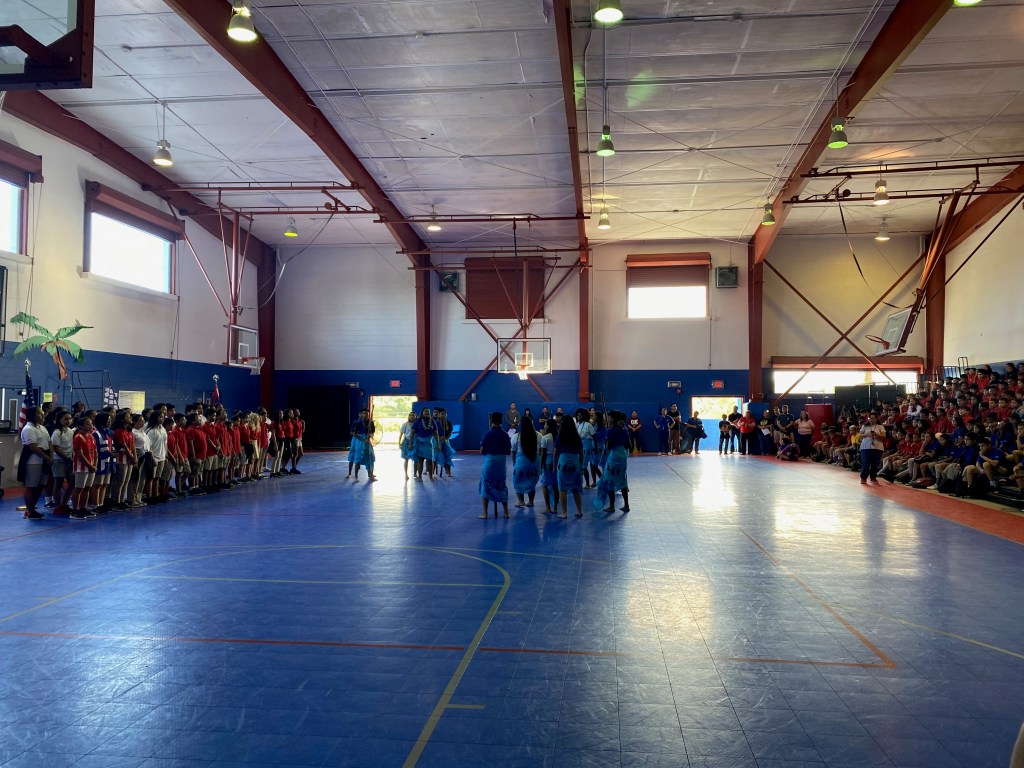
In this featured article photo taken at Oceanview Middle School in March 2020, Mes Chamoru, known in English as Chamoru Month, is celebrated with an opening ceremony in the school gym, complete with the Chamoru blessing and cultural performances. “Mes Chamoru is all about celebrating and sharing Guam’s unique culture, heritage and history. It’s a month of many exciting special events and fun activities centered around the best of Guam’s food, culture and Hafa Adai spirit“ (Mes Chamoru: Guam History and Cultural Heritage Month, March 6, 2015).
At Oceanview Middle School, there are many educational and community events that make the Cultural Dance and Chamorro Language learning very important and integral to the OMS school identity. Led by Cultural Dance and Chamorro Language Instructor Ray Lujan and Chamorro Language and Chamorro Crafts Instructor Joey Leon Guerrero, together these two forces of Chamorro Culture and Knowledge have groomed Oceanview students for decades on Chamorro culture.
Culture influences development from the moment we’re born, making an impact on us as we grow. For instance, culture can affect how children build values, language, belief systems, and an understanding of themselves as individuals and as members of society. … Children can receive these cultural influences in different ways, such as through their parents, their environment, and the media. How society shows an understanding of diverse cultures can impact a child’s development in many ways, such as how confident in themselves or how comfortable interacting with others they become as adults (Cultural Influences on Childhood Development, April 8, 2021) .
In the greater island community, Oceanview students’ knowledge of culture contributes greatly to the local economy. Through cultural dance performances at local government and corporate events, to family and small village gatherings, the students of Oceanview Middle School share their knowledge and identity with the other Guam communities. With this spread of knowledge, the spread of tangible and intangible — economic factors — becomes apparent.
Cultural goods, services and activities generate both jobs and income, promote the exchange of knowledge and values, foster social cohesion, and improve quality of life (Perez, 2013).
UNESCO has given top priority to this issue (of culture) … which promote(s) cultural diversity as a driver for development. Culture can help foster economic activity. Tangible and intangible heritage, cultural infrastructure, creative industries and cultural tourism make a significant contribution to comprehensive development, alleviate poverty, encourage social inclusion, and generate jobs and economic benefits (Perez, 2013).
So the teaching of cultural knowledge that comes from Chamoru Instructors such as Saina Ray Lujan and Sinot Joey Leon Guerrero has lasting impact on the identity of the Oceanview children, who spread their knowledge to the greater Guam communities. The social cohesion of cultural practices among all the cultural groups across the island spawns creativity and economic activity that generates jobs and encourages social interaction among Guamanians and visitors alike. Whether the students are Chamoru, Filipino, Chuukese, Pohnpeian, Palauan, or from the stateside, the Hafa Adai Spirit and the spirit of inclusion and cohesiveness allow the OMS students to share their cultural knowledge among each other and with the world beyond the OMS campus, for the betterment for ALL who call Guam home.
Biba Oceanview! Biba Guam! Biba Tourism!
Sources:
- Mes Chamorro: Guam History and Chamoru Heritage Month. (2015, March 6). Guam Tourism Leisure and Travel Blog. https://www.visitguam.com/blog/
- Cultural Influences on Childhood Development (2021, April 8). Maryville Online. Cuhttps://online.maryville.edu/blog/cultural-influences-on-child-development/
- Perez, V. (2013, September). The Contribution of Culture to Economic Development in a Small Cuban Town. http://www.lacult.unesco.org/docc/gibara_ingles.pdf
 Ice Cream Banana